The Business of Software - Unfiltered and Unplugged. Part 1 - Understanding Services Firms
Published on Apr 28, 2025 by Mihir Thakkar
Meet Sneha, a junior developer who has just joined a software company. To her, it was all about the passion: building cool apps, learning the latest frameworks, making an impact.
But a year in, she feels stuck. She is working late nights on endless client calls, fixing bugs in an old codebase, and wondering why she is not growing the way she imagined.
It is not that she is not smart or hardworking. More likely, she has ended up in the wrong type of business, the wrong project, or sometimes just with the wrong people.
This post is for every Sneha out there, whether you are working in a software company today or aspire to start your own company one day. I will try to lift the curtains on what really goes on behind the scenes.
Why You Should Understand The Business Side
Understanding the business side of software companies is like zooming out and seeing the whole casino, not just your own cards. It is not just about playing smart moves. It is about knowing who is funding the players, who is bleeding money, and who is quietly making a fortune.
Suddenly, it starts to make sense why you are stuck fixing bugs in legacy code instead of building something new: that "boring" maintenance project may actually be paying your salary.
You realize why your colleague with the same experience is getting paid 2x more: they are on a billable project, and you are not.
It also explains why your most innovative ideas on an R&D project sometimes get shelved: nobody paid for them in the first place.
Once you see it, you can never unsee it. And it changes the way you play the game.
Software Services Companies Vs Product Companies
Unlike most industries that lean heavily toward either products, like cars, soft drinks, and smartphones, or services, like CAs, lawyers, and banks, software is one of the rare fields where both models thrive side by side.
You have service giants like Infosys, Accenture, and TCS building software for others, and product powerhouses like Microsoft, Adobe, and Atlassian building and selling their own IP.
- Services firms build intellectual property for others. Think outsourcing projects, custom development, and client apps.
- Product companies build intellectual property for themselves. Think SaaS apps, consumer apps, and platforms.
On paper, product companies sound sexier. But when it comes to survival?
Nearly 47% of service companies make it through their first five years. Only 25% of tech-based startups can say the same. Statistically, you are almost twice as likely to "make it" as a services business than as a technology product firm. [1]
Moreover, most services companies aspire to build their own products, but for most, it remains a dream or just a sales strategy. Very few manage to succeed at both.
On the flip side, many product companies, once they hit saturation, start offering professional services to boost revenue and stay close to their biggest customers.
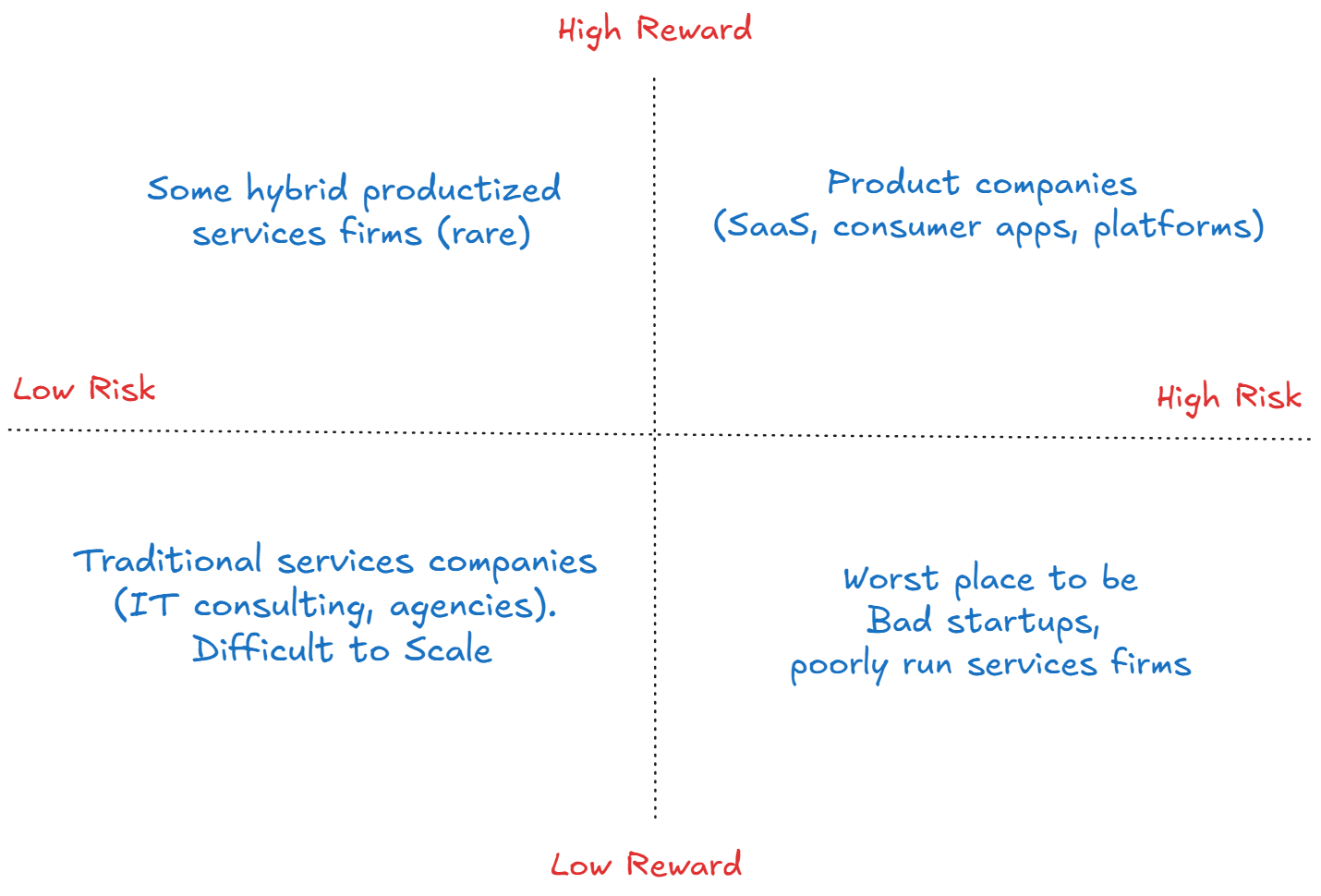
Today, we are going to dive deep into the first type: services firms. We will uncover how they actually run, how they make money, and what no one tells you when you first join one.
How Services Firms Make Money
At its core, a services firm makes money by renting out smart people's time for more than it costs to hire and retain them.
But there are many ways to package and sell that time.
Hourly Billing
You clock hours and send a monthly invoice. If you have ever worked for a client who says, "Just keep track of your time and send me the timesheet at the end of the week," that is hourly billing.
It is flexible, but unpredictable for both sides.
Fixed-Price Projects
Here, you quote a flat fee upfront: $20,000 for a mobile app, $50,000 for a new CRM system.
If you finish faster, you win. If the project drags, you bleed. This model can be profitable or disastrous depending on how well you scope the work.
Retainers
Retainers are monthly fixed payments for ongoing work, such as maintaining a client's servers or building new features every month.
They are the holy grail for services firms because they give predictable cash flow.
Outcome-Based Pricing
This is riskier, but has high upside.
You get paid based on results. For example: "We will rebuild your checkout flow, and if your conversion rate improves by 20%, you pay us a bonus."
Very few firms do this well because it needs immense trust and clear metrics.
What Actually Matters To Stay Profitable
All the fancy billing models boil down to a few cold, hard numbers.
Billable Hours
How much of your team's time is actually paid for by a client?
When you are discussing the perfect name for your internal tool that nobody will use, that is non-billable time.
Utilization Rates
Utilization rate is a fancy term for "how busy your people are."
For example, if you have a developer on a Rs. 15 lakh salary and they are adding only 20 hours per week on client timesheets, your company is probably losing money.
Most firms target greater than 80% utilization for healthy margins.
Margins
Margins decide everything: from your salary hikes to your promotion chances, to whether your project gets extra staffing or you end up working weekends.
Gross margin is the money left after you pay your project delivery team: developers, PMs, designers, and others.
Operating margin is what is left after covering all operating costs: corporate salaries, HR, office rent, laptops, support staff, and everything else.
Simple rule:
- If the cost is essential to delivering a project, it is a direct cost.
- If the cost is for running the company and is not tied to a specific project, it is overhead or indirect cost.
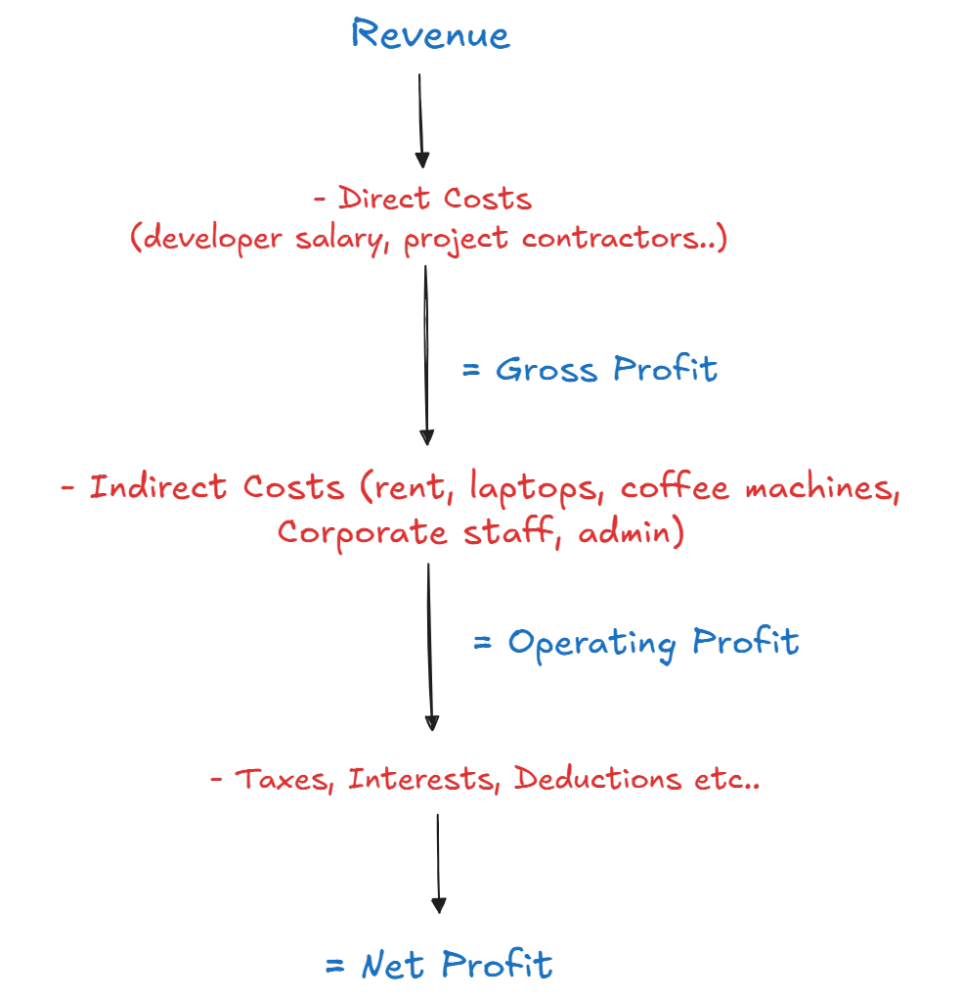
A well-run services firm aims for 15-30% net margin. Anything below 10% and you are essentially one bad quarter away from layoffs.
- Below 10% margin: high stress, survival mode.
- 10-20% margin: okay business, but vulnerable to shocks.
- 20-30% margin: healthy, growing firm.
- 30%+ margin: either you are exceptional or underpaying your people massively.
What Determines Salary Levels In Services Firms?
Ever wonder why your appraisal this year does not reflect the hard work you have put in? Services firms, behind the scenes, have very simple math running.
First, it is about client billing rates. If the company can only charge $20 per hour for your work, you will likely be paid less than someone whose work can be billed at $50 per hour.
Second, company overheads matter. Bigger offices, more management layers, fancier parties, and luncheons all have to be paid for somehow. Your billing rate needs to cover it.
Third, it is the classic supply versus demand game. Hot skills, like AI engineers today, can demand crazy salaries simply because there are not enough people who can do the job well.
Apart from these, in my opinion, everyone from freshers to senior leadership eventually falls into one of four categories. And honestly, this determines your earning potential more than your degree or certification ever will.
1. Individual Contributors
You are amazing at your craft: writing code, designing UIs, writing test cases.
Unfortunately, individual contributors, especially in services firms, often sit at the lower end of the salary spectrum. Not because they are not valuable, but because they are replaceable faster.
That said, exceptions are becoming common. If you are in a niche skill or an in-demand tech stack, you can punch way above.
2. People Who Manage Other People
Team leads, project managers, and delivery heads fall into this category.
If you can take five noisy engineers and turn them into a team that delivers a project on time, you are immediately more valuable. You are not just selling hours anymore. You are selling outcomes.
3. People Who Bring In Other Talented People
Recruiters, engineering leaders, and even senior developers who can attract ex-colleagues to join the firm fall into this category.
Talent attracts talent, and companies know it. If you have a reputation where good people want to work with you, you will see it reflected in your salary and bonuses over time.
4. People Who Bring In Revenue
These are the rainmakers: sales heads, client partners, and senior delivery managers who own large accounts.
These are the people who can open doors, close deals, and expand projects. They are not just an expense on the P&L sheet. They directly create revenue.
In any services firm, rainmakers get paid the most, protected the most, and forgiven the most.
Pro tip: the more overlaps you create, for example being an individual contributor plus a people magnet plus good with clients, the stronger your position. You are no longer "just another engineer." You are someone who moves the business.
How Are Services Companies Structured Internally?
You probably already have a good sense of this. But let us go beyond activities and look at core responsibilities.
1. Engineering And Delivery
This is the engine room of the company: the developers, testers, architects, project managers, and everyone else who actually builds what the client is paying for.
Their job is simple but brutally hard:
- Deliver projects on time.
- Deliver projects within budget.
- Keep the client happy enough to pay more later.
In most services firms, delivery is king. If the delivery team fails, no matter how good the sales team is, clients will not come back.
2. Sales And Business Development
This is where the magic of bringing money in happens.
Initially, it may happen through word of mouth. Later, it becomes structured business development: pitching proposals, negotiating contracts, and sometimes babysitting large accounts to keep them growing.
Good sales and business development teams:
- Understand what clients really want, not just what they say.
- Package their company's services to match those needs.
- Set up delivery teams for realistic promises, not impossible ones.
In smaller firms, you will often see senior delivery managers double up as salespeople. In larger ones, it is a separate department with quotas, commissions, and endless pipeline meetings.
3. HR And Recruitment
In services companies, HR is not just about engagement surveys and birthday cakes.
Their real day-in, day-out job is recruiting fast and cheap, especially when new projects land and headcount ramps need to happen overnight.
Good HR and recruitment teams are worth their weight in gold:
- They find and close good talent before the competition.
- They manage the messy stuff, like offers, joining, and exits, with minimal drama.
- They sometimes even save projects by finding replacements fast.
4. Finance And Admin
Not glamorous, but absolutely critical.
They manage invoices, make sure clients actually pay, and keep track of salaries, taxes, expenses, compliance, and vendor payments.
In most services companies, the finance team also plays a low-key role in decision-making. If a client delays payments or a project is running over budget, finance is often the first to raise the alarm.
Without a sharp finance team, even a company doing Rs. 50 crores in revenue can crash and burn purely because of poor cash flow management.
What Are The Major Risks For A Services Firm?
From the outside, services firms can look steady: revenue coming in, big client logos flashing on the website.
But under the hood, they carry serious risks that can blow up fast if not managed well.
Here are the four biggest.
1. Client Concentration Risk
Imagine 70% of your revenue coming from just one or two big clients. If even one of them pulls the plug, you are staring at layoffs, salary freezes, and office shutdowns overnight.
Good services firms constantly try to diversify their client base. Bad ones get addicted to one whale client until one day, the whale swims away.
2. Project Delivery Risks
Every services firm lives and dies by project delivery.
Two common killers:
- Scope creep: clients keep adding new features and requirements, but your fixed-price contract stays the same. Suddenly, a profitable project becomes a loss-making headache.
- Quality issues: missed deadlines, buggy releases, unhappy clients. One bad delivery and you lose trust, renewals, and referrals, which in services are your lifeblood.
Good project management is not about Gantt charts. It is about protecting margins while keeping the client feeling cared for.
3. Talent Churn And Dependency
If your top five engineers, PMs, or sales stars walk out tomorrow, will the company survive?
Many services firms quietly depend on a handful of key people who know the clients, manage the chaos, and get things done.
High employee churn, especially among senior folks, can tear apart client relationships and delivery predictability, which hits revenue directly.
4. Pricing Pressure And Commoditization
In a world where a client can post a project on Upwork or find a vendor in Vietnam, Poland, or the Philippines, how do you stay competitive?
Services firms constantly battle two ugly forces:
- Clients demanding more work for the same price.
- New competitors willing to do the same work cheaper.
Without strong differentiation, such as specialized skills, deep domain knowledge, or superior delivery, even established firms can get sucked into a race to the bottom.
Wrap-Up: The Real Business Behind Writing Code
If you have only seen services firms from the seat of an engineer, project manager, or tester, you might have felt frustrated at times.
But once you understand the business engine, how money flows in, how risks are managed, and how margins are protected, the whole game starts to make sense.
It is not just about delivering good code. It is about building a machine that can deliver good software profitably, repeatedly, and predictably.
In Part 2, we will explore the other flavor of this industry: product-based companies.
We will step into the flashier side:
- The world of VC funding and sky-high valuations.
- The bootstrapped underdogs who quietly build profitable empires.
- Metrics like CLV, customer lifetime value, and CAC, customer acquisition cost, and why they matter so much more in product businesses.
- The brutal truth: why building a successful product company is 10x harder but can be 100x more rewarding.
Was this helpful? Let me know in the comments. It helps the LinkedIn algorithm gods show it to more people who might find it useful. It also keeps me motivated to keep putting out content like this on the side while I build companies.
References
[1] Fishkin, Rand. Lost and Founder: A Painfully Honest Field Guide to the Startup World. Portfolio, 2018.